Future Of Time Tracking for Enterprise Teams
Lauren Mitchell

Introduction
The future of time tracking is no longer about asking employees to remember what they did at the end of the day. For enterprise teams, that model is too slow, too manual, and too fragile. Large organizations need accurate data, flexible workflows, privacy-aware systems, and insights that help leaders improve productivity without creating unnecessary friction.
As AI, automation, and workforce analytics become more common, time tracking is evolving from a simple timesheet tool into a strategic layer of business intelligence. This article explores what is changing, why it matters, and how enterprise leaders can prepare.

Why Traditional Time Tracking Is Reaching Its Limit
Traditional time tracking was built for a simpler workplace. Employees started timers, filled out timesheets, and managers reviewed hours after the fact. That may work for small teams, but it becomes unreliable in enterprise environments.
Large teams deal with multiple departments, time zones, tools, clients, compliance requirements, and hybrid schedules. Manual time entry creates gaps. Employees forget to track time, choose the wrong task, or estimate work hours later. For HR and operations teams, that means less reliable reporting.
The enterprise problem
At scale, inaccurate time data affects more than payroll. It can impact project profitability, workforce planning, client billing, compliance, and productivity analysis. A small reporting issue repeated across hundreds or thousands of employees becomes a serious operational problem.
The future of time tracking solves this by moving from manual records to automatic work data. Instead of depending on memory, companies will capture activity more consistently across company devices, apps, projects, and workflows.
AI and Automation Will Redefine Time Tracking
AI time tracking will help companies understand work with less manual effort. Instead of only recording hours, future systems will recognize work patterns, suggest project categories, automatically classify applications, websites, and digital environments as productive, unproductive, or unclassified, detect unusual activity, and identify productivity trends.
Rather than forcing administrators to manually categorize thousands of apps and URLs, intelligent systems will continuously learn from organizational behavior and recommend classifications automatically. This reduces administrative work while providing a clearer view of how working time is distributed across different types of activities.
From Tracking Time to Understanding Work
The biggest change is not automation itself. The real shift is interpretation. Future time tracking tools will not simply answer, “How many hours were worked?” They will help answer better questions:
Which workflows create the most interruptions?
Which teams are overloaded?
Where are projects losing time?
Which tools support focus?
Where does productivity drop?
This turns time tracking into productivity intelligence. For business owners and operations leaders, that is far more valuable than a static timesheet.
Privacy Will Become a Core Product Feature
As tracking becomes more advanced, privacy will become more important. Enterprise teams cannot treat privacy as an afterthought. Employees need to know what is collected, why it is collected, and how the data will be used.
Recent discussions around workplace monitoring show that overly invasive tracking can create resistance, reduce trust, and raise legal concerns. The lesson is clear: better technology does not automatically mean better management.
The future is transparent by design
Future time tracking systems should include role-based permissions, data minimization, configurable tracking rules, clear retention policies, and privacy-friendly reporting. In many cases, managers do not need to see every individual detail. Aggregated trends may be enough to improve planning and productivity.
The strongest enterprise systems will balance visibility with restraint. They will give leaders useful insights while avoiding unnecessary surveillance.
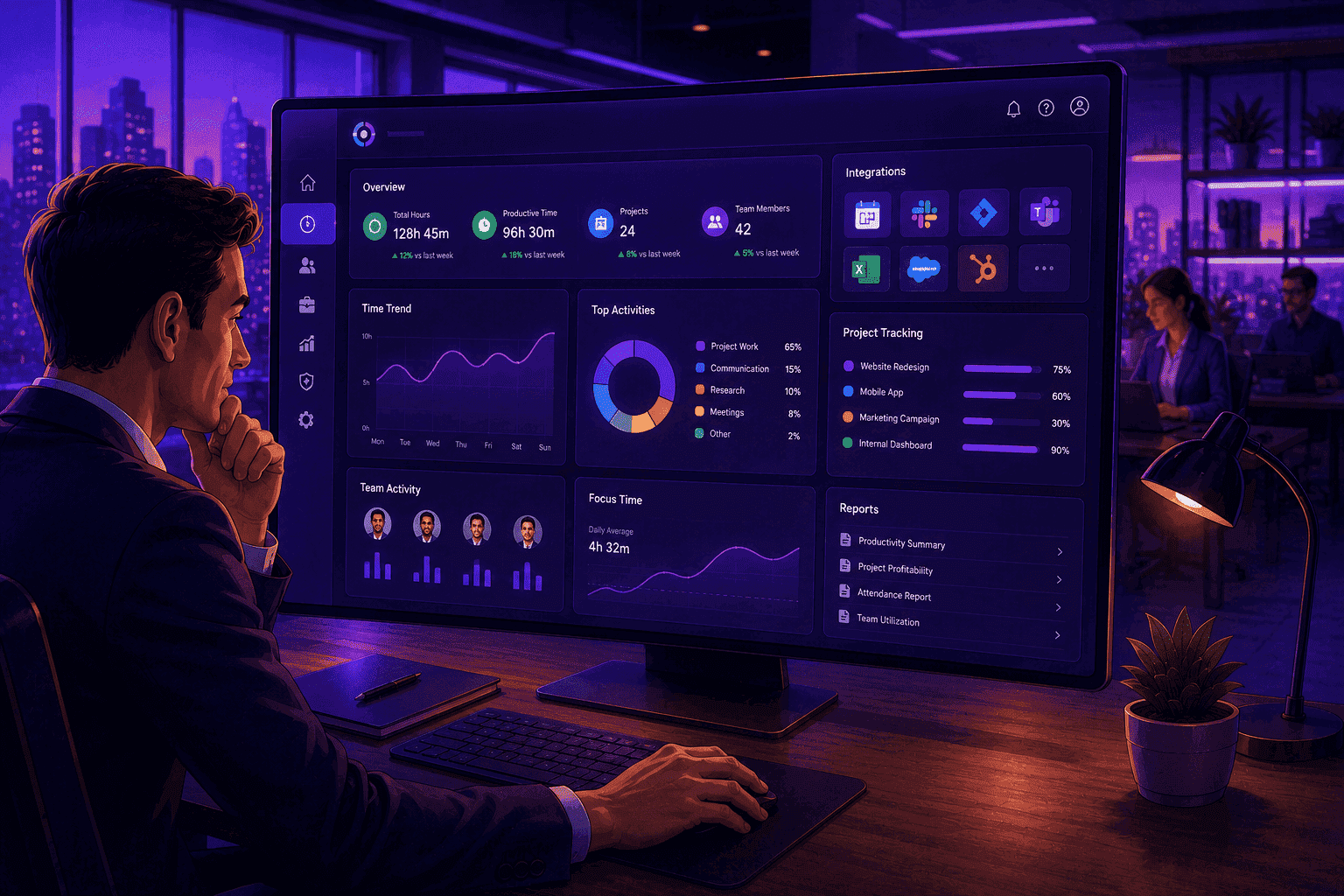
Enterprise Time Tracking Will Connect More Systems
The future time tracking stack will not live alone. It will connect with payroll, HR platforms, project management tools, invoicing systems, identity providers, and workforce management software.
This matters because time data becomes more powerful when it is connected. A project manager can compare estimated hours with actual work. HR can understand workload pressure. Finance can evaluate labor costs. Operations can identify bottlenecks across departments.
Integration creates better decisions
For enterprise teams, the value is not just tracking. It is turning time data into decisions. When time tracking connects with other systems, leaders can understand how work affects cost, delivery, productivity, and staffing.
This also reduces duplicate work. Employees should not have to enter the same information in multiple tools. The future will favor systems that quietly collect, organize, and share data across the business.
How Leaders Should Prepare Now
Companies do not need to wait for the future to start improving. The best preparation is to build better habits today.
Start by defining what time tracking should accomplish. Is the goal payroll accuracy, productivity optimization, compliance, project profitability, or workload visibility? Each goal requires different settings and communication.
Next, create a clear policy. Explain what is tracked, when tracking happens, who can access the data, and how it supports the business. Transparency will make adoption easier.
Finally, train managers to use time data responsibly. Time tracking should support coaching, planning, and process improvement. It should not become a shortcut for micromanagement.
Quick Takeaways
Future time tracking will be more automatic and less dependent on manual input.
AI will help classify work, detect patterns, and reduce timesheet errors.
Enterprise teams will need stronger privacy and access controls.
Productivity insights will matter more than raw hours.
Integrations will connect time data with payroll, projects, and operations.
Transparent communication will be essential for employee trust.
Conclusion
The future time tracking is automatic, intelligent, connected, and privacy-aware. For enterprise teams, the opportunity is not just better timesheets. It is better visibility into how work happens.
Organizations that adopt this mindset will be able to improve productivity, reduce administrative work, support compliance, and make smarter workforce decisions. The companies that succeed will be the ones that use time data to improve work, not simply monitor it.



Try OrbityTrack for 7 Days!
Boost Productivity.
Turn data into results.
Gain full visibility over your team.
Start Your Free Trial